
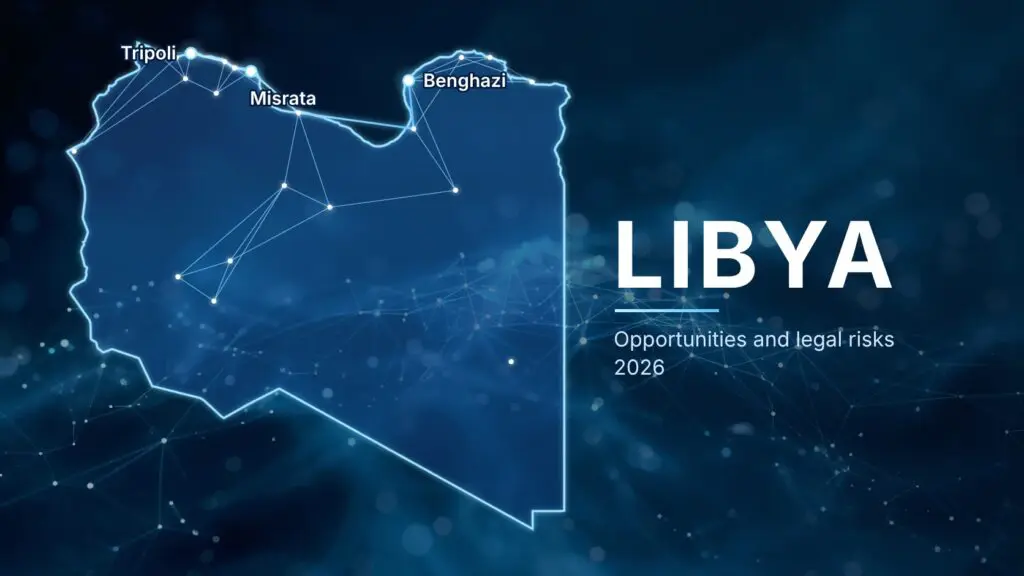
Libya offers significant growth opportunities for foreign companies, particularly in energy, infrastructure, construction, healthcare, water and telecommunications. The recovery in oil production, the adoption of a unified budgetary framework and substantial reconstruction needs are helping to renew international investor interest.
Against this backdrop, SRDB Law Firm advises international businesses and investors on structuring and safeguarding their operations in Libya. Working with its partner Abdou Law Firm (ALF), a Tripoli-based law firm, SRDB combines its expertise in international business law with an in-depth understanding of Libya’s legal, institutional and economic environment.
While the opportunities are real, the business environment remains subject to institutional, financial and security uncertainties. For foreign companies, the challenges extend beyond securing a contract to identifying the authority empowered to enter into it, accessing foreign currency, ensuring reliable payment channels and assessing the practical options for resolving disputes.
Establishing a presence or conducting commercial operations in Libya requires careful legal preparation that takes account of both local constraints and international considerations from the outset.
Key takeaways
Three issues should be examined before making any commitment.
Companies must first verify the identity, authority and legal capacity of their Libyan counterparty. They must then secure financing and payment arrangements. Finally, they must develop a realistic dispute resolution strategy that reflects the practical conditions for enforcement in Libya.
Legal advice combining international expertise, knowledge of Libyan law and familiarity with local practices helps businesses anticipate these difficulties and address risks from the project structuring stage.
A genuine but still fragile economic recovery
Libya’s economy remains heavily dependent on hydrocarbons. Between 2021 and 2024, the oil and gas sector accounted for approximately two-thirds of GDP and nearly 90% of public revenue. This concentration exposes economic activity, public finances and the balance of payments directly to oil price fluctuations, production disruptions and tensions surrounding energy infrastructure.
Growth forecasts for 2026 reflect this uncertainty. The International Monetary Fund has projected growth supported by rising oil production. Other institutions take a more cautious approach given persistent political, fiscal and security risks.
According to the World Bank, the agreement on a unified public expenditure framework of 190 billion Libyan dinars for 2026 represents a significant development. It is an attempt to restore common budgetary planning after several years of fragmentation. However, the agreement alone does not guarantee consistent implementation of public spending or the elimination of parallel financial channels.
For foreign companies, the essential question is therefore not simply whether Libya has resources or economic needs, but under what conditions these can translate into enforceable contracts and payments that can actually be received.
The principal risk lies in contract performance
Libya continues to be characterised by competing centres of power in the east and west. In the west, the authorities are primarily represented by the Government of National Unity led by Abdulhamid Dbeibah. Eastern Libya remains under the influence of distinct political authorities and forces.
This fragmentation can complicate the identification of the competent authority, the granting of permits, the approval of public contracts and coordination between administrative bodies. It can also create uncertainty as to which person or entity is ultimately responsible for payment.
Before signing, foreign companies should therefore verify the signatory’s authority, the contracting entity’s powers, the necessary approvals and the ability of the public or private body to commit its resources lawfully. Such due diligence is particularly important where a contract involves a government authority, a state-owned enterprise or an entity operating in a strategic sector.
The fact that a Libyan entity has signed a contract does not guarantee that it will be able to obtain foreign currency, open a letter of credit, secure approval of import documentation or access the necessary budgetary allocations.
The collaboration between SRDB Law Firm and Abdou Law Firm enables these issues to be addressed from the earliest stages of negotiations, taking into account both the requirements of Libyan law and the constraints of international transactions.
Persistent foreign exchange and payment pressures
Increased oil production does not eliminate financial vulnerabilities. The Libyan market remains exposed to a significant gap between the official and parallel-market exchange rates. This disparity can increase import costs, complicate contractual pricing and reduce the real value of payments received in local currency.
Access to letters of credit is another key issue. These instruments are essential to many import transactions, particularly in the pharmaceutical, industrial, energy and construction sectors. Delays in the issuance, approval or settlement of a letter of credit may force foreign companies to finance inventory, wages, transport and logistics costs themselves.
In an article published on 7 October 2026, Africa Intelligence reported payment delays at the Central Bank of Libya that were undermining the import activities of several French companies operating in the country. Such situations illustrate how an economically viable contract can remain stalled by banking or documentary difficulties or a lack of foreign currency.
Payment risk must therefore be assessed from the contract negotiation stage. Companies should examine the issuing bank, correspondent banks, drawing conditions, required documents, processing times and the consequences of refusal or delay.
A letter of credit does not provide an absolute guarantee. Its effectiveness depends on documentary compliance, the solvency and policies of the bank concerned, the availability of foreign currency and the banking system’s practical ability to process the transaction.
Reconstruction needs create genuine opportunities
These risks do not mean that the Libyan market is closed. Reconstruction needs are substantial, particularly in infrastructure, water supply and sanitation networks, energy, medical equipment, telecommunications, transport and technical services.
French companies are already active in several of these sectors. According to the French Treasury Directorate General, French exports to Libya reached €448 million in 2025, an increase of 50% year on year. Mechanical and electrical equipment, pharmaceuticals, agricultural products and food products are among the main export categories.
This commercial momentum is accompanied by renewed institutional interest. Economic forums and French business delegations have been organised to identify opportunities in both eastern and western Libya.
For companies seeking to enter this market, project success depends as much on identifying opportunities as on managing legal and operational constraints.
Three priorities before establishing a presence or entering into a contract
When advising businesses seeking to develop their activities in Libya, SRDB Law Firm and its local partner focus on three essential areas: contractual and financial safeguards, regulatory compliance and dispute preparedness.
Securing contracts and financing
The contract should specify the payment currency, conversion arrangements, documents required for settlement, payment deadlines and the consequences of late payment.
Where possible, companies should negotiate milestone payments, secured advance payments, bank guarantees, on-demand guarantees, escrow arrangements or credit insurance. They may also provide for the right to suspend performance if payment is not made within the agreed period.
Foreign exchange clauses require careful drafting. They may provide for a price adjustment mechanism, an obligation to pay in hard currency or renegotiation in the event of a significant exchange rate fluctuation.
Documentary procedures should also be clearly defined. Inspection certificates, customs documents, certificates of conformity and proof of delivery must be precisely identified. The contract should specify which party is responsible for obtaining them and address the consequences of changes in administrative requirements.
Finally, the contract should allocate risks arising from site closures, transport disruptions, shortages of foreign currency or suspension of works on security grounds. Force majeure and hardship clauses should address notice requirements, preservation of evidence and the conditions for resuming performance or terminating the contract.
Conducting due diligence on counterparties and financial flows
Due diligence should cover the contractual counterparty, its beneficial owners, management, intermediaries and the banks involved.
Companies should also assess applicable sanctions, asset-freezing measures, the nature of the goods or services being exported and any rules governing sensitive or dual-use items. This assessment is more than a documentary formality: it may determine whether the contract can be performed and payment received at all.
Any subcontractors, commercial agents and local partners should also be identified. Companies may face sanctions exposure or reputational risks through intermediaries whose activities or beneficial owners are not sufficiently known to them.
Planning for dispute resolution and enforcement
The contract should specify the governing law, competent courts or arbitral institution, seat of arbitration, language of proceedings and conditions for obtaining interim measures, as applicable.
An arbitration clause may be advantageous, particularly where the effectiveness and timescales of local court proceedings are uncertain. However, it does not guarantee payment.
Before selecting an arbitration mechanism, companies should assess the prospects for recognition and enforcement of an award, any immunities enjoyed by a public-sector counterparty and the location of assets potentially available for enforcement.
A dispute resolution strategy should therefore be developed during negotiations. Companies should retain contracts, purchase orders, delivery certificates, invoices, correspondence with banks, payment reminders and acknowledgements of receipt. A properly documented claim will be easier to negotiate, insure, finance or recover.
SRDB Law Firm in Libya: International and Local Expertise
SRDB Law Firm operates in Libya in collaboration with Abdou Law Firm (ALF), a Tripoli-based law firm licensed since 2013, under a partnership agreement. ALF joined SRDB Worldwide Network and SRDB Alliance in late 2024, strengthening SRDB Law Firm’s capacity to advise clients in North Africa.
Drawing on its expertise in international business law, contractual structuring, compliance and dispute resolution, SRDB Law Firm advises companies on their development projects and cross-border transactions. In Libya, this expertise is complemented by Abdou Law Firm’s knowledge of local law, administrative procedures and the business environment.
ALF’s practice includes arbitration, corporate law and banking law. The firm also has experience in infrastructure projects and the restructuring of joint ventures involving Libyan companies and European partners. Ranked by The Legal 500 for North Africa, it works in Arabic, English and French.
The complementary expertise of the two firms enables them to provide coordinated legal support at every stage of a project:
- Before commencing operations: risk assessment, verification of counterparties and their authority, legal and contractual structuring, compliance and payment safeguards.
- When establishing a local presence: selection of the legal structure, establishment of subsidiaries or branches, relations with local partners and regulatory procedures.
- During contract performance: monitoring contractual commitments, addressing payment difficulties, preserving rights and anticipating dispute risks.
- In the event of a dispute: amicable negotiations, enforcement of guarantees, debt recovery and arbitration or court proceedings.
This joint approach enables businesses to benefit from legal advice that addresses both the international dimensions of their operations and the specific legal, institutional and economic features of the Libyan market.
Libya: pursuing opportunities through a risk-managed strategy
Libya’s economic development prospects and reconstruction needs offer genuine opportunities for foreign companies. Realising these opportunities nevertheless requires careful preparation and an understanding of the market’s specific characteristics.
Anticipating legal, financial and operational risks, safeguarding contractual commitments and engaging advisers with both international and local expertise are key to developing sustainable business activities in the country.
Through its partnership with Abdou Law Firm, SRDB Law Firm advises international businesses and investors on the preparation, structuring and implementation of their projects in Libya.
Are you considering establishing a presence, investing or conducting commercial operations in Libya? Contact our team to discuss your project.
Sources and references
Institutional sources
- French Treasury Directorate General — Bilateral economic relations with Libya, June 2026.
- International Monetary Fund — Regional Economic Outlook: Middle East and Central Asia, April 2026.
- World Bank — Macro Poverty Outlook – Libya.
- U.S. Department of State — 2025 Investment Climate Statements: Libya.
Specialist press
- Africa Intelligence — Central bank crisis leaves French companies caught in a payment arrears trap (title translated from French), 7 October 2026.


